
Pie
An AI-powered growth product manager agent for app developers. The tool for the phase after you build.
AI solved the building problem. Tools like Cursor, Claude Code, and Codex let one person ship production software in days. But nobody solved the post-ship problem: monitoring metrics across five tabs, correlating a DAU drop with the release you pushed Tuesday, figuring out if your paywall experiment is working. Pie is the AI tool for the phase after you build.
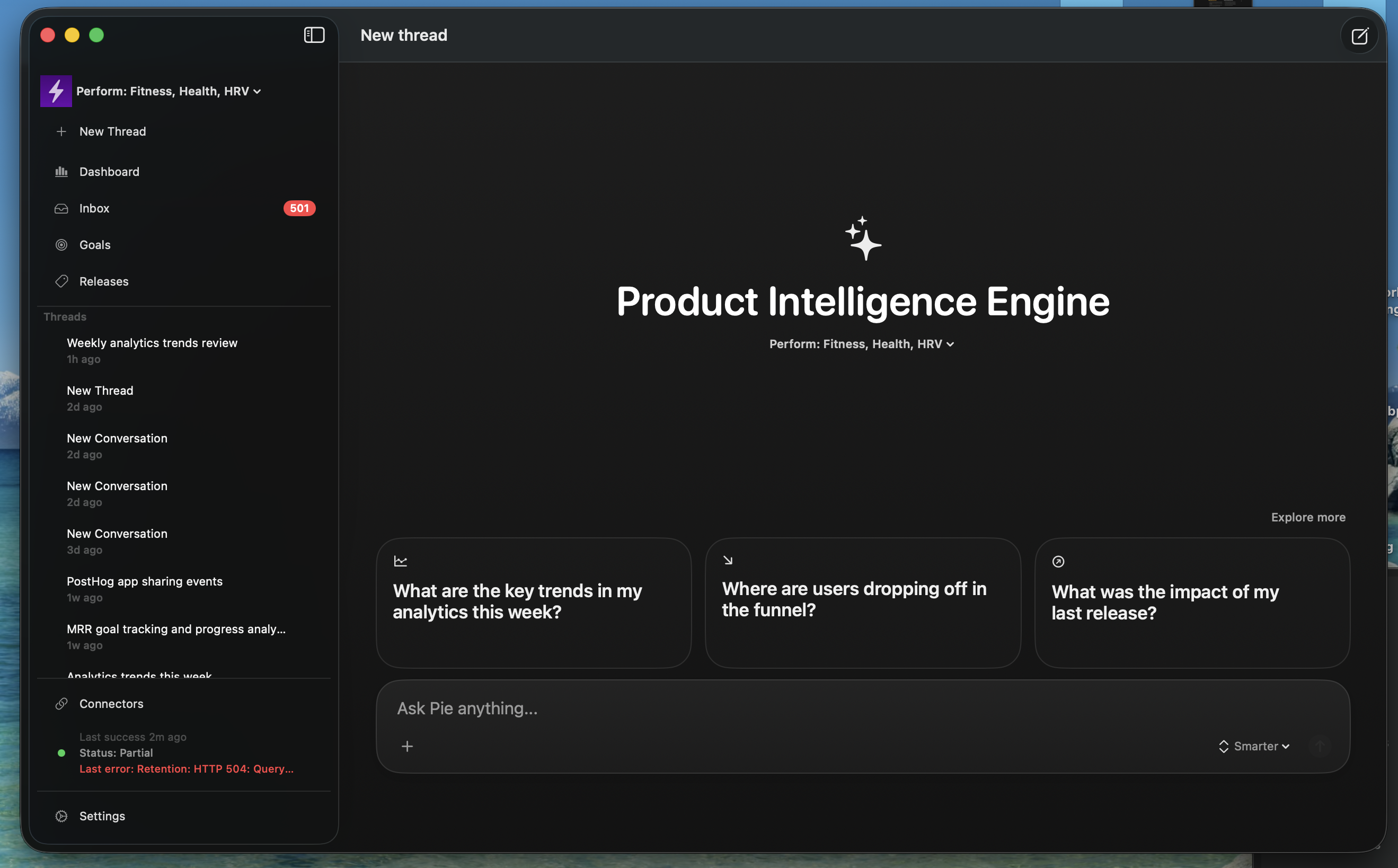
I designed Pie around a specific opinion: a product-health tool shouldn't look or feel like a dashboard. Dashboards are for looking at, and I didn't want a tool that sat there waiting for me to notice something. I wanted a collaborator. So the home surface is a chat, not a grid of charts. You ask Pie questions, it investigates, and it comes back with an answer and the receipts. The dashboard exists, but it's secondary.
Pie is a native macOS app that acts as a product management and product health agent for app developers. It connects to the tools developers already use (PostHog, RevenueCat, Superwall, GitHub, App Store) and uses Claude's agentic tool-use API to monitor metrics, investigate anomalies, correlate code changes with metric shifts, and tell you exactly how to improve your app.
Developers set growth goals inside Pie, and the agent works toward them. It tracks progress against your targets, surfaces what's helping and what's hurting, and recommends specific next steps. Instead of digging through dashboards, you get a goal-aware agent that ties every insight back to what you're actually trying to achieve.
The standout feature is Release Impact. Every time you ship a new version, Pie automatically computes a weighted impact score by comparing pre-release baseline metrics to post-release performance across multiple time windows. It detects confounding factors like nearby releases or missing metric coverage, and gives you a clear, honest read on whether your release actually moved the needle.
Under the hood is a 4-tier analysis system designed to solve alert fatigue. Cheap heuristic monitoring handles volume at zero API cost. When something meaningful fires, Claude automatically investigates by pulling metric context, checking recent commits, reading actual source code, and producing an analysis with causal attribution and confidence scoring. On top of that, daily briefs compare metrics to historical baselines, and weekly deep dives identify long-term trends across 60- to 90-day windows.
When Pie links a metric change to a code commit, it uses structured confidence bands and says "correlates with" rather than "causes." Users can rate any alert, and the feedback is injected directly into system prompts to calibrate the AI's conservatism over time. Call it prompt-level RLHF without any model fine-tuning.
The entire product was built by one person. Native SwiftUI and SwiftData, five data source integrations, a tiered AI system, and a custom design system tuned for reading long AI responses quickly. It's a proof of what's possible when AI-assisted development meets strong product instinct.
Highlights
- Designed the entire product: chat-first home, dashboard, Release Impact, onboarding, and a custom design system tuned for AI-first reading
- Chat-first architecture: the agent is the primary surface, the dashboard is secondary
- Release Impact: automatic weighted scoring of every release against baseline metrics
- 4-tier analysis system that solves alert fatigue at the architecture level
- Causal attribution from code to metrics with structured confidence bands
- Connects PostHog, RevenueCat, Superwall, GitHub, and the App Store
- Prompt-level RLHF that calibrates AI accuracy without model fine-tuning
- Built solo as a native macOS app in SwiftUI and SwiftData